Women have always been part of urban mobility — as the majority of public transport users worldwide, as the workers who keep systems running, as the planners and engineers quietly shaping the cities we all move through. And yet, for decades, transport systems have been designed without their experience at the table, without their data, without their voices shaping the decisions that affect them most.
“Women in Motion: Agadir, vers une mobilité plus sûre et inclusive” set out to change that. For two days in the capital of the Souss-Massa region, those voices were not a footnote — they were the foundation of the entire conversation.
The event was organised by GIZ Morocco under the Sustainable Mobility with Renewable Energies (DKTI VI) project, in partnership with the Ministry of Energy Transition and Sustainable Development, the Wilaya de la Région Souss-Massa, and SDL Agadir Mobilité. Women Mobilize Women was proud to be part of it.
Mobility as more than infrastructure
The opening remarks set a tone that carried through the entire event. The Wali of the Souss-Massa Region, Saaïd Amzazi, framed mobility not as a technical challenge, but as a social one: a lever for economic development, access to education, healthcare and public life.
Se déplacer en ville ne renvoie pas seulement à une question de trajet ou de temps. Cela touche aussi à la sécurité, à la lisibilité de l’espace public, à l’égalité d’accès aux services, à l’emploi, à l’éducation et, plus largement, à la participation à la vie sociale.
Moving through a city is not only a matter of route or time. It also touches on safety, the legibility of public space, equal access to services, employment, education and, more broadly, participation in social life.
Saaïd Amzazi, Wali de la Région Souss-Massa
This framing is essential. For too long, transport planning has focused on moving people from A to B. What Women in Motion made visible is that this approach has never been neutral, it has consistently left out the experiences of women, people with disabilities, and others whose mobility needs are more complex, and more revealing of how a city actually functions.
GIZ has been working in Morocco since 1975, and this event reflected the depth of that partnership: a commitment not just to technical cooperation, but to the kind of dialogue that produces real change. The presence of UITP — with whom GIZ has a Memorandum of Understanding — alongside UN Women, AFD, and a wide range of national institutions and civil society organisations, made this a genuinely multi-stakeholder space. And that, as the two days made clear, is not incidental. It is essential.
A city already in motion
Agadir is not starting from zero. The city is in the middle of a significant urban transformation — 247 new buses recently integrated into the network, and the launch of the first BHNS line, Amalway Trambus, designed around accessibility, regularity and comfort. Women in Motion built on this momentum, asking not just how to move people, but how to move everyone.
[smartslider3 slider=”3″]The women who move Agadir
One of the most striking moments of the conference was a panel dedicated entirely to celebrating the women who keep Agadir moving every day: motorcycle traffic officers, bus drivers, driving instructors, safety technicians, community association leaders. Not invited as symbols or as representatives of a problem to be solved — but as professionals with expertise, experience and vision.
This is at the heart of what WomenMobilizeWomen does. We work to make visible the women who are already transforming the transport sector from the inside, because visibility is not just recognition. It is the precondition for policies that actually reach them: you cannot design for people you cannot see.
[smartslider3 slider=”4″]Leadership in action
And it was not only on the ground. Another session brought together women leading some of the most significant organisations in Morocco’s mobility sector: public operators, private transport companies, international organisations and development finance institutions. Their trajectories made visible something that statistics alone cannot convey: that women are not waiting to be invited into leadership in this sector. They are already there, already building, already transforming.
[smartslider3 slider=”6″]
From gender-sensitive to gender-transformative
A theme that ran through both days was the distinction between adapting transport for women and transforming it with them. Being gender-sensitive means recognising different needs and adjusting services, while being gender-transformative means questioning why those needs were ignored in the first place, and changing the structures, the data, the decision-making processes that produced that gap.
Aymane Saidi from UN Women put it clearly: care work — the trips to school, the errands, the responsibility for others that falls disproportionately on women — is inseparable from how we think about mobility. When we collect data only on commuters going to work in the morning, we are making an invisible choice about whose movement counts. Closing the gender data gap is not a technical exercise. It is an act of recognition.
And as Lindsey Barr from UITP said in her keynote: this is not only about women. Transport that works for women works better for everyone — for older people, for children, for people with disabilities. Men need to be active participants too, not as allies standing aside, but as co-builders of systems that serve the whole city. This is something Lindsey embodies beyond her role at UITP — as a co-founder of Femmes en Mouvement, a French network advancing gender equality in mobility, and a member of the Global Alliance for Feminist Transport, the first global hub on feminist transport co-founded by Women Mobilize Women together with Mujeres en Movimiento and Women on the Move Asia. The Alliance exists precisely because this work cannot happen in silos.

Bridging worlds, deepening dialogue
What made the conversations go as deep as they did was also a matter of who held the room. Yasmine Elkerouani brought something rare: more than two decades of experience in media, a practice deeply rooted in amplifying women’s voices, and the perspective of a journalist and a woman of this territory. Her ability to navigate between institutional discourse and lived experience — making space for both without flattening either — reflected exactly what this event was designed to be: a genuine multi-stakeholder platform where government authorities, transport operators, civil society organisations, international partners and community voices were not just present, but in real dialogue with one another.

Beyond the panels
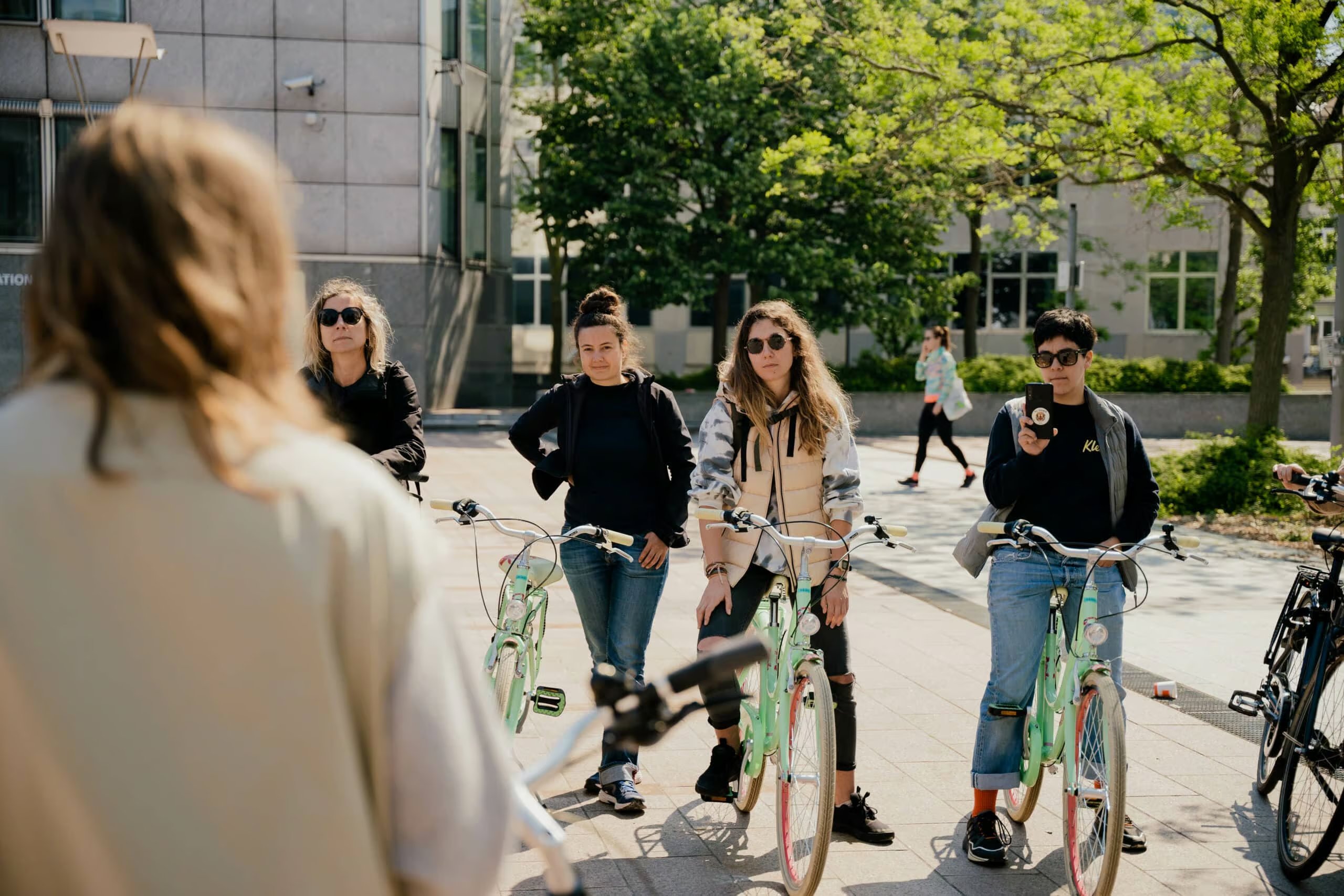
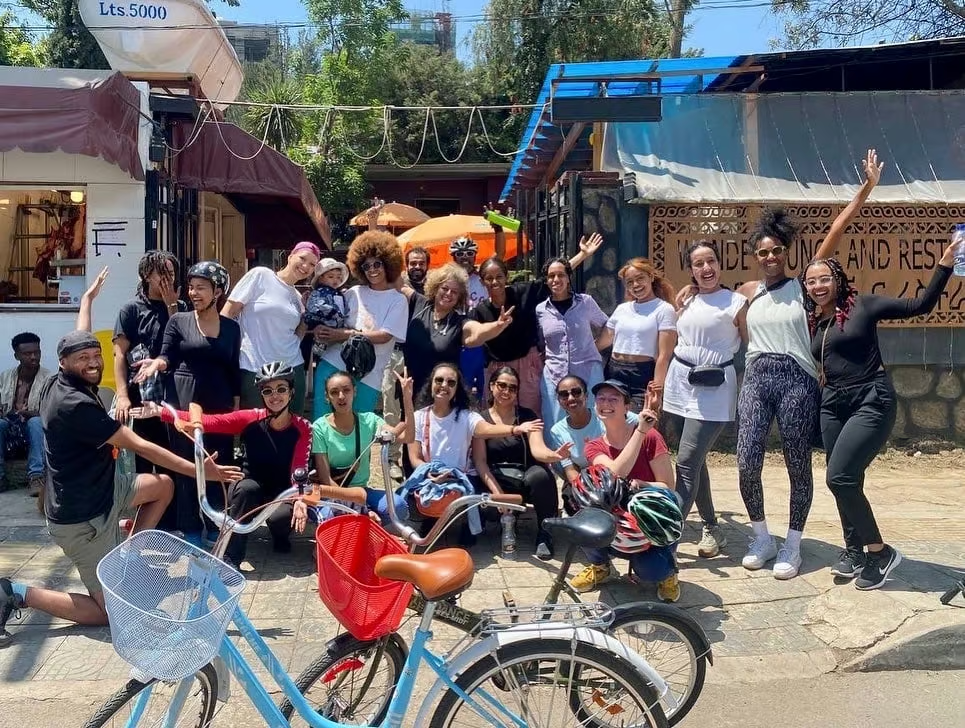
The conversations did not stay inside the conference room. On the afternoon of the first day, participants joined Pikala Bikes — a social enterprise founded by Cantal Bakker with a mission to make cycling accessible to all Moroccans, including through free cycling lessons for women and girls — for a ride along the Agadir coastline. With 650 women having learned to cycle through their programmes, Pikala is proof that the right to move freely through a city can be built, one lesson at a time.
[smartslider3 slider=”5″]What Agadir showed us
What made Women in Motion remarkable was the room itself: government authorities, transport operators, civil society organisations, international partners, all around the same table. Mobility is not only infrastructure. It is access to education, work, healthcare, public life. Decisions about who gets to move, how, and safely, cannot be made by one actor alone.
Women Mobilize Women leaves Agadir with new connections, new ideas, and the conviction that what is being built here deserves to be shared far beyond its borders.