Nearly one in three women engaged in cross-border trade in Central Asia operates informally. A regional initiative, implemented together with the Kurak Women’s Forum and the Association of Customs Brokers of Tajikistan and Uzbekistan, set out to change what that invisibility costs them — reaching 235 women across six border regions with legal, financial, digital, and health knowledge.
At border crossings in Kyrgyzstan, Tajikistan, Kazakhstan, and Uzbekistan, women carry heavy boxes on foot or by public transport, crossing several times a week, moving goods for resale and acting as informal logistics providers for smaller companies. According to the International Trade Centre (ITC), 90% of these women simultaneously manage household responsibilities alongside their trading activities, and half run micro-businesses with fewer than ten employees. This work keeps regional supply chains moving and creates employment for women who would otherwise have no formal economic foothold. And for decades, it has been almost entirely invisible in policy, in data, and in the formal economy.
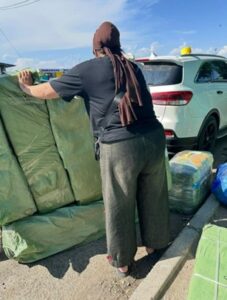
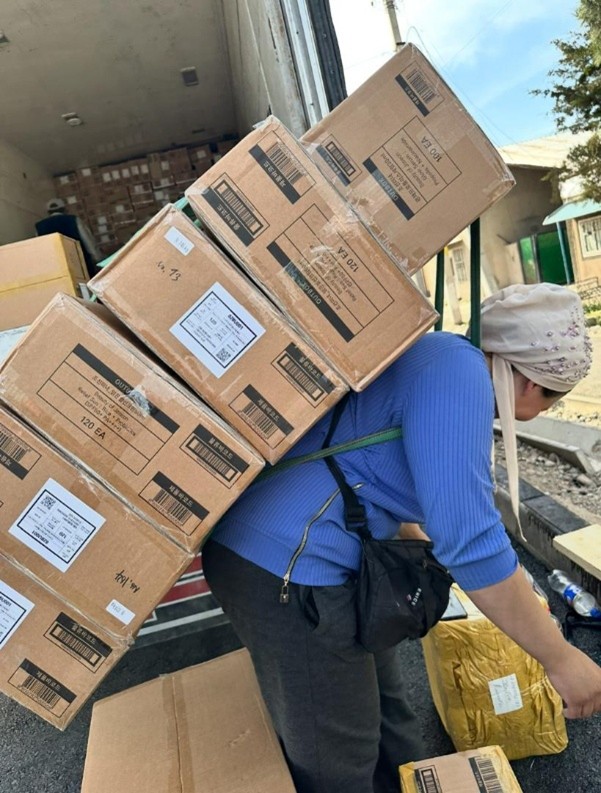
A woman shuttle trader at the Kyrgyzstan-Kazakhstan border. Photo taken with her consent.
These women are shuttle traders. Between May and December 2025, a regional trade facilitation initiative, implemented together with the civil society organisation Kurak Women’s Forum and the Association of Customs Brokers of Tajikistan and Uzbekistan (ATB), addressed the structural barriers that keep them outside the formal economy.
A system that was never built for them
In early 2025, a feasibility study was conducted with the Kurak Women’s Forum across Kyrgyzstan’s border regions. What it found was not a lack of ambition or capacity, but a system that had never been designed with these women in mind. Women shuttle traders largely operate outside formal legal frameworks, often unaware of business registration options and their rights at border crossings. This informal status bars access to credit, insurance, and social protection, while exposing women to corruption, arbitrary fines, and confiscation of goods with no formal recourse. Most carry heavy loads manually under unsafe conditions, with chronic musculoskeletal consequences that existing frameworks have never addressed. Traditional gender norms and restricted mobility further prevent women from formalising or expanding their businesses.
The study also identified high potential: targeted training on legal, digital, and business skills could shift women’s roles from informal traders to legally recognised entrepreneurs and community leaders. This insight became the basis for a gender-transformative theory of change, focused on addressing the root causes of inequality and working with change agents in both state and civil society.
| 1 in 3 | 90% | 235 |
| women in cross-border trade operate informally (ITC) | combine trading with full household responsibilities (ITC) | women trained across six border regions |
Seven modules, one clear message: you have rights
Between May and September 2025, the initiative reached 235 women across six border regions of Kyrgyzstan, with additional sessions in Dushanbe and Khujand, Tajikistan. The curriculum was built as seven interconnected modules: the Gender Action Learning System (GALS), a participatory methodology grounded in women’s own goals; legal and customs regulations covering border-crossing rights and registration requirements across Kyrgyzstan, Tajikistan, and Kazakhstan; financial literacy and budgeting; business planning and market analysis; digital platforms and e-commerce, including practical use of Instagram and AI-assisted tools; accounting and record-keeping as prerequisites for formal credit access; and health, ergonomics, and wellbeing at border crossings, addressing the chronic physical consequences of shuttle trade. After the sessions, WhatsApp peer support groups were established to sustain mentoring and information-sharing. 72% of participants remained active in these groups, using them to navigate business registration and share updates on customs regulations.
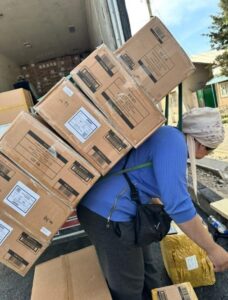
The physical reality of shuttle trade: carrying loads of this scale across border checkpoints is a daily routine. Photo taken with her consent.
A cafe, a workshop, a studio: and a register with their names in it
Three stories stay with you after reading the outcomes. Gulzira from Chaldovar: after 15 years in informal trade, she used the business planning and legal literacy modules to register her business and opened a cafe near the border crossing. Tazagul from Kyzyl-Kiya: she turned her trading activity into a small mattress production workshop, creating stable local employment in the process. Zarina from Osh: she launched a podology studio and built her client base through Instagram, applying the digital tools module directly.
Each path was different, but the ingredients were the same: legal knowledge, financial planning skills, digital tools, and the confidence that formalisation was achievable rather than prohibitively complex.
These are not isolated cases. Across the six regions, women began registering their businesses, adopted digital tools to expand their market reach, and reported a significantly stronger understanding of their rights at border crossings. Beyond individual outcomes, the initiative strengthened cooperation between women traders, customs officials, and local authorities, building trust and transparency along the borders. An income that had existed only in cash and word-of-mouth now has legal standing, and businesses that operated invisibly are now searchable, registered, and growing.
Gender-neutral reform produces gender-unequal results
Trade facilitation is typically measured through border crossing times, documentary compliance costs, and WTO agreement implementation rates. On these metrics, Central Asia has made genuine progress: Uzbekistan’s national trade facilitation roadmap reached an implementation rate of 89% in 2023, and Kyrgyzstan has developed a national trade portal to reduce export costs. But the WTO Trade Facilitation Agreement provisions on transparency and appeal procedures, theoretically available to all traders, are inaccessible in practice to women operating informally, who are unaware of these rights and have no pathway into formal processes. Women shuttle traders also do not operate within a single national border: a woman based in Osh crosses into Tajikistan and Kazakhstan in the same week. This initiative is among the few gender-sensitive trade facilitation efforts in Central Asia designed with explicit regional scope across multiple national jurisdictions.
Progress that reduces average trade costs does not automatically reach women who carry goods on their bodies, operate outside formal market structures, and have no legal status to invoke when things go wrong.
The border has not changed. The women crossing it have.
The outcomes of this initiative point toward a policy conversation that has not yet fully happened in Central Asia: what would it take to create a formal, safe, and legally recognised pathway for women shuttle traders into the regional economy? The peer networks built through the training are a sustained channel for advocacy that did not exist before. The partnership with the Kurak Women’s Forum and the ATB, supported by local women’s associations, chambers of commerce, and national trade facilitation committees, offers a replicable model for state-civil society cooperation on gender and trade. And the women who have registered their businesses are now visible in formal data systems, generating evidence that reform processes can actually use. The women crossing these borders did not need to be discovered. They were always there, always essential to regional supply chains. What they needed was a system that could finally see them.
This post is based on a trade facilitation initiative implemented in cooperation with the Public Association “Kurak Women’s Forum” and the Association of Customs Brokers of Tajikistan and Uzbekistan (ATB). Duration: May to December 2025. Countries: Kyrgyzstan, Tajikistan, Uzbekistan, and the wider Central Asian region.